Accelerate your career today!


Engineered for the Scan: Why Your Resume Format Is Costing You Interviews in 2026
In the high-stakes world of engineering recruitment, the structural showdown of a chronological vs functional resume 2026 candidates must navigate determines whether an application succeeds or fails. Your technical prowess is only as good as your ability to communicate it, and today’s hiring landscape has shifted entirely from human-centric screening to a sophisticated, multi-layered algorithmic filter. If your CV is structured incorrectly, you are not just losing the interest of a hiring manager; you are being mathematically eliminated before a human ever sees your name.
The debate between a chronological vs functional resume is no longer a matter of personal preference or aesthetic taste. It is a strict question of system compatibility and narrative logic. For the modern engineer, choosing the wrong framework is like trying to run high-level simulation software on an outdated operating system—it simply will not execute. To compete effectively in the current market, your professional presentation must undergo a thorough performance review.
The Core Contenders: Chronological vs Functional
To understand which format wins the modern job application race, we must first deconstruct the mechanics, advantages, and inherent failures of each layout style.
The Gold Standard: Reverse-Chronological Performance
The reverse-chronological format remains the undisputed industry standard for global engineering recruitment. This layout organizes your work experience in strict reverse order, starting with your current or most recent role at the top and moving systematically backward through your career history.
- Logic: It prioritises your current level of seniority, your most mature technical achievements, and your immediate workplace responsibilities.
- Recruiter Value: It provides human readers with an immediate “velocity check,” showing exactly how you have progressed from early technical roles into senior engineering, project management, or business leadership positions.
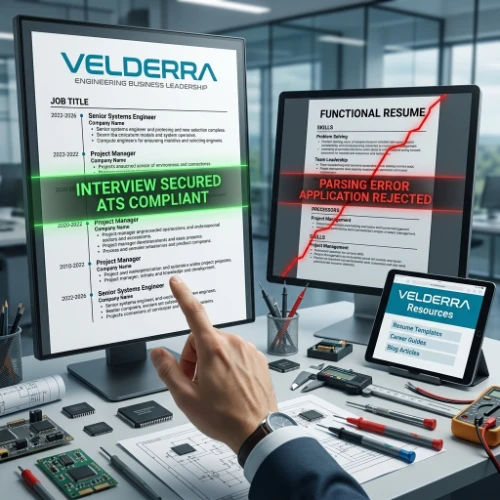
- ATS Compatibility: Modern parsing algorithms are programmed to expect this linear logic. They can instantly extract your job titles, company names, promotions, and tenures without encountering data corruption.
The Red Flag: Why the Functional Format Fails the Modern Test
A functional resume (frequently called a skills-based resume) deliberately de-emphasises the timeline of your career to focus almost entirely on isolated skill clusters. While this sounds highly logical for a multi-disciplinary engineer who wants to showcase diverse technical capabilities, it is fraught with extreme risk in the current job market.
- The Trust Gap: To an experienced technical recruiter, a functional layout is an immediate warning sign. Because it hides the timeline, it is frequently associated with attempts to mask significant employment gaps, extreme job-hopping, a lack of recent hands-on engineering experience, or a demotion.
- The Parsing Nightmare: Most automated Applicant Tracking Systems (ATS) struggle to map standalone skills to specific calendar dates when using this format. If the system cannot verify exactly when or where you utilized a specific tool or methodology, it may assign it zero weight in your final matching score.
Behind the Screen: How Modern ATS Algorithms Parse Your Data
The software used by tier-one engineering firms, infrastructure giants, and technology disrupters has become highly aggressive in its data logic mapping. Modern systems do not just scan for isolated keywords or phrases; they evaluate contextual authority.
The Importance of Linear Logic Mapping
When an automated parser reads a reverse-chronological resume, it builds a structured data map of your career. For example, it identifies that you used Project Management and Systems Engineering at a specific company between 2022 and 2026. This allows the system to credit you with four solid years of continuous experience in that specific competency.
Conversely, in a functional resume, you might list “Project Management” as a bold headline with several impressive bullet points beneath it, but your actual employers and dates are relegated to a separate, sparse list at the bottom of page two. The parser frequently fails to link the skills to the timeline, leading to an artificially low relevance ranking. Your technical brilliance is effectively erased by the software.
The Self-Sabotage of Complex Layouts
Many engineers attempt to make their documents stand out by using complex multi-column Word files, graphic progress bars for their skills, or embedded tables. These design choices are catastrophic for your application. Standard single-column layouts remain the most resilient against parsing errors, ensuring your data is read precisely as intended.
The Hybrid Blueprint: A Strategic Middle Ground
Is there ever a time to break the chronological rule? Yes—but only through the disciplined deployment of a Hybrid (or Combination) Resume.
The Hybrid format takes the best elements of both worlds. It begins with a powerful, tailored Executive Summary and a highly targeted Technical Expertise Matrix at the top of page one. This structure allows you to front-load your tech stack, certifications, and leadership credentials, giving both the algorithm and the human reader immediate value. Crucially, this introductory block is backed by a robust, reverse-chronological professional experience section that forms the backbone of the document.
When to Deploy the Hybrid Strategy:
- The Career Pivot: If you are moving away from specialized technical execution (e.g., a Senior Structural Engineer) and stepping into a broader operations, management, or commercial leadership role.
- Sector Transitions: When the skills most relevant to your target job were gained a few years ago, but your most recent project work is less aligned with where you want to go.
- The Over-Experienced Veteran: If you have more than twenty years of industry experience and need to highlight your modern technological capabilities while summarising your early career history efficiently.
Industry-Specific Guidance: Tailoring Your Logic
Not every engineering discipline should be formatted identically. The search parameters and indexing protocols used for a Software Architect differ significantly from those used for a Civil Project Manager.
Civil, Structural, and Mechanical Engineering
Recruiters in these traditional fields are looking for structural project delivery, capital expenditure management, and strict regulatory compliance. You should utilize a clear chronological format but incorporate a dedicated “Selected Major Projects” subsection under each specific employer. This keeps your timeline fully intact while highlighting your concrete, real-world triumphs.
Software, DevOps, and Systems Engineering
The modern technology stack changes rapidly, meaning your specific toolsets must be instantly scannable. A hybrid approach works beautifully here. A dedicated “Technical Environment” block should sit directly beneath your executive summary on page one, categorising languages, cloud architectures, and frameworks, followed immediately by your chronological history.
Engineering Management and Business Leadership
For engineers transitioning into executive or business leadership roles, your resume must shift focus from “what you engineered” to “what you delivered for the business.” This demands a strict chronological framework that highlights profit and loss (P&L) responsibility, team headcount management, vendor negotiations, and strategic return on investment (ROI).
The Practical Rules for Modern Hiring
To ensure your professional CV is completely optimised for automated filters and human eyes, follow these three non-negotiable rules:
Rule 1: Prioritise Trajectory Over Design
Always default to a reverse-chronological flow unless you meet a very specific exception. The risk of being mis-parsed by an automated system far outweighs the perceived benefit of a “creative” functional layout. Your primary goal is to make the recruiter’s initial scan completely effortless.
Rule 2: Eliminate Formatting Friction
Modern professional documents must be exceptionally clean. Remove all tables, nested text boxes, graphics, charts, and custom icons. Use standard, clear headings like “Professional Experience” rather than creative variations, and keep your date formats completely uniform throughout the document (e.g., MM/YYYY or Year – Year).
Rule 3: Frame Gaps Transparently
Never use a functional layout as a shield to hide a career break. Transparency is a major professional asset. If you took time away from the industry for personal development, parental leave, or family care, state it briefly and confidently directly in your timeline. This demonstrates integrity and corporate maturity—qualities that are highly valued in modern engineering leadership.
Final Verdict: Which Format Wins?
The clear winner is the Hybrid Reverse-Chronological Resume.
It is the only layout strategy that successfully satisfies all key stakeholders in the modern recruitment chain:
- The Automated Parser: Because it follows a predictable, time-stamped, linear timeline.
- The Technical Recruiter: Because it allows them to execute an immediate, six-second relevance and trajectory scan.
- The Engineering Director: Because it explicitly links your technical competencies to proven commercial outcomes and leadership growth.
Stop Fighting the Editor: Deploy an ATS-Optimised Blueprint
You should not have to spend your weekends acting as a graphic designer or a systems analyst just to get your professional profile read. At Velderra, we have engineered the administrative complexity out of the resume-writing process entirely. Our clean, battle-tested frameworks ensure your technical capabilities and leadership profile display flawlessly on every recruiter’s screen.
Visit the Velderra Shop today to access:
- Professionally Engineered Templates: Tailored frameworks built explicitly to showcase technical milestones and leadership metrics.
- Strategic Skill Guides: Structured toolkits designed to help you master non-technical competencies and expand your corporate influence.
- Personalised Advisory Support: Connect directly with our team for expert guidance tailored to your ongoing professional and personal growth.
Don’t let an outdated layout format stall your professional momentum. Optimise your presentation strategy today.
Frequently Asked Questions
Which resume format passes ATS software most reliably?
The reverse-chronological format is the most reliable structure for automated parsing. Its clean, linear timeline allows matching algorithms to accurately index your career progression and assign time-weighted value to your technical skills without data corruption.
Should I use a functional resume to hide short employment gaps?
No. Recruiters view functional layouts as an immediate red flag indicating hidden career issues. It is far more effective to use a reverse-chronological layout and explain any career breaks transparently in your executive summary or cover letter.
When is a purely functional resume acceptable?
A purely functional resume is almost never acceptable for standard engineering roles. It should only be deployed by highly specialized, project-based contractors or consultants whose simultaneous client portfolios cannot logically be mapped to a single linear timeline.
How can I verify that my engineering resume is ATS-compatible?
Avoid using complex Word text boxes, embedded graphics, tables, or non-standard fonts. The most secure approach is to utilize a single-column framework designed specifically for technical professionals, such as the templates available in the Velderra resources section.